Department Stores and AI Product Content: A 7-Step Guide to Building Brand-Trained Visual Infrastructure

Introduction
Your latest floor set lands Monday, and half the SKUs still have flat-pack shots next to six-figure advertising creative. That visual disconnect isn't a photography problem. It's a content supply chain stuck in the 2000s.
Department stores rely on a volume and variety of goods that breaks traditional photoshoot economics. Sampled garments queue for weeks. Categories like menswear demand precise collar roll, shoulder pitch, and lapel drape that a generic mannequin shot never quite delivers, yet explaining those nuances to a rotating crew of freelance photographers eats the margin on every batch.
November 2026 marks a real turning point. Retailers are no longer experimenting with single-point AI tools. They are wiring artificial intelligence into the core operating system of product content.
AI bot traffic to retail sites grew more than five times from 2024 to 2025, per Botify data pulled from 200 retail and e-commerce sites. Meanwhile, department stores deploying AI-generated on-model imagery are seeing 15 to 30% higher conversion rates on product pages. The shift is measurable, and the foundation is clean, machine-readable structured data.
This guide walks you through a seven-step build-out, from product data hygiene to a scorecard for evaluating a managed AI visual infrastructure partner. It is written for the merchant, the digital operations lead, and the marketing director who need to turn a fragmented photoshoot calendar into a production pipeline that scales with weekly new arrivals.
Key Takeaways
Department stores that treat AI imagery as a fast alternative to a traditional shoot will spend more and get less. What works is a connected stack: structured product data feeds into a visual model trained on your brand, delivering imagery that lifts conversion by 15 to 30% on product detail pages. The five priorities below spell out what that stack requires.
The foundation. AI engines parse product entities, not keyword density. Department stores need to shift from stuffed product description paragraphs to schema.org markup and clean data feeds before any generation tool delivers reliable output. Without that, the model is guessing, and the output looks generic.
Scale and speed take a measurable jump. Brand-trained visual infrastructure reduces traditional photoshoot costs by 40 to 60% while producing publishable on-model and lifestyle imagery in a fraction of the time. For a department store with thousands of SKUs cycling through weekly arrivals, those savings compound fast.
The conversion lift is the payoff. Retail deployments have linked AI-generated on-model imagery to that 15 to 30% lift on product detail pages, driven by one thing shoppers respond to: consistent brand presence across every category, not just the categories that got a full creative budget.
The supply chain gains are real but quiet. Managed AI pipelines integrate directly with PIM and DAM systems, enforce quality assurance, and kill the sample-shipping ping-pong that delays seasonal launches. Photography stops being a bottleneck and becomes a step in the data pipeline.
Evaluating a partner in 2026 is structural work, not a feature comparison. It means scoring brand-training accuracy, platform integration depth, output fidelity, data security, and measurable ROI through a structured proof-of-concept.
Step 1: Shift from keyword-stuffed pages to AI-readable structured product data
Department stores spent a decade stuffing product detail pages with keyword variations because it worked for ten blue links. That playbook is now a liability. AI crawlers and discovery algorithms read entities, not keyword density. Botify's global VP of AI, AJ Ghergich, notes that many AI bots struggle to read and parse JavaScript and other page elements. If your product truth is locked inside a paragraph of marketing copy and a JavaScript-loaded image gallery, the machine that is about to answer a shopper's query may never find it.
Target updated its website to be machine-readable for both internal and external AI engines, and that is exactly the bar a department store must clear. The foundation is schema.org Product markup, backed by a product ontology stored in a clean PIM. Every variant, color, material, care instruction, and fit attribute lives as a discrete, extractable field. This structured product data fuels generative copy, dynamic imagery, personalized landing pages, and conversational shopping agents that will query your catalog over the next eighteen months.
Clean data is a strategic asset.
Step 2: Deploy generative AI for automated product descriptions and dynamic copywriting
Structured data without a production engine is a library without a printing press. The concrete workflow starts once product attributes sit in a reliable PIM.
Connect the PIM to an LLM pipeline tuned on your tone-of-voice guide: Feed the structured fields (material, silhouette, use-case, care, brand story paragraph) as a prompt grounding set. The system writes from data, never hallucinates from an empty prompt.
Generate, localize, and variant-test in a single batch: Output the base description, three localized versions for key markets, and a shorter variant optimized for AI-assisted search. Supplement maker Olly added a frequently asked questions section directly to product pages to capture LLM traffic asking use-case questions; department stores should mirror this by auto-generating structured FAQ blocks from the same data.
Route every batch through human-in-the-loop QA: Generative copy can drift into claims that violate the brand's merchandising standards. A reviewer approves the batch, flags recurring failure patterns, and feeds corrections back into the prompt template. This loop makes the model smarter over successive catalog refreshes rather than forcing a rewrite sprint every season.
Step 3: Implement brand-trained AI models for consistent on-model imagery and virtual photoshoots
Generic AI image generators fail department stores in two predictable ways:
Collar roll on a tailored blazer: comes out wrong because the model was trained on a billion images of suits at gala events, not on your brand's specific shoulder pitch and button stance.
Brand identity and creative standards: the model does not know your logo, approved color palette, or lighting ratio your creative director insists on, while a competitor using the same off-the-shelf library can generate on-model imagery that looks like yours with a few clicks.
A brand-trained platform solves this by learning your visual language before producing a single on-model shot. Lumesa's Brand DNA system, for instance, captures over 200 visual attributes from a brand's reference images. This is not about a style transfer filter. The model encodes your exact collar construction, your hemline curvature, your drape behavior on specific fabrics, and your flat-lay composition rules. Once trained, you stop re-prompting every garment and chasing hemline distortions. The output arrives consistent with fit standards and color fidelity across categories.
The operational math is straightforward:
Photoshoot cost reductions of 40 to 60%: arrive when you stop renting studio space, shipping trunk samples, and booking models for basic catalog shots source.
Content production accelerates by 3 to 5 times: when a trained model generates on-model imagery from a new product reference image instead of scheduling a shoot source.
Conversion lift of 15 to 30% for AI-generated on-model imagery: is the downstream metric that closes the business case source. Shoppers see the product on a consistent, brand-right model, not suspended on a ghost mannequin, and they convert at a measurably higher rate.
A virtual photoshoot is not a simulation of a studio. It is an entirely new production asset that eliminates the bottleneck between finished sample and live product page. From a single flat-lay or packshot upload, the system can generate on-model images, lifestyle scenes, social assets, email banners, and marketplace listings at once. The Monday shipment does not sit in boxes waiting for the next available studio window.
Step 4: Integrate AI-powered virtual try-on and content multiplication features
On-model imagery starts the customer journey. Virtual try-on and content multiplication finish more of them. Here is how a department store maps these capabilities against its customer decision funnel, and what each demands as an integration prerequisite.
Feature | What it does for the shopper | Platform requirement | Expected uplift |
Virtual try-on (garment drape and fit mapping) | Renders the product on a shopper-selected avatar or uploaded photo, showing real drape and fit before a size decision. | Plug-and-play integration with the storefront; must accept flat-lay or packshot inputs. | Higher session engagement; measurable reduction in size-related return rates. |
Content multiplication (background/angle/pose variants) | Auto-generates product image variants from a single reference shot, exposing the garment in multiple contexts without manual reshoots. | Direct tie-in with the brand-trained image model; output rendered at editorial-grade resolution for every channel. | Broader product exposure per SKU; customers see the item in their use-case context. |
Both features land most directly on the product detail page, but the architecture must push the generated variants across web, email, and paid channels without breaking brand consistency. The campaign travels with the shopper into try-on, the storefront, ads, and email. Plug-and-play ecommerce integrations exist today. The bottleneck is whether the underlying image model produces on-brand output across every multiplied variant.
Step 5: Apply personalization engines and LLM optimization techniques for AI-assisted discovery
Product content that is perfectly structured and visually brand-trained still fails if the right shopper never sees the right variant. Personalization engines and LLM-optimized discovery close that loop. The mechanism starts with vector embeddings. Every product, description, image variant, and attribute set gets encoded as a dense numerical representation. A shopper who searches "linen blazer for a garden wedding" hits a retrieval-augmented generation (RAG) layer that matches the intent vector against your catalog, pulls the most relevant products, and grounds an LLM to generate a conversational response that references actual SKUs.
This is where enriched structured data earns its keep. A product page that carries clean material, occasion, and climate metadata surfaces correctly in a vector search. A page that buried "garden wedding" inside a 200-word paragraph does not.
The personalization layer builds on top. NielsenIQ confirms that personalization algorithms lift performance when they tailor content layout and product ranking to real-time user signals. A returning bridal-party shopper sees linen options first.
A first-time visitor in a cold-weather zip code sees merino. The structured product data enables the segmentation. The trained visual system generates the variant that the personalization engine then serves.
I have yet to see anyone who has north of 5% of their revenue attributed to AI, Ghergich told Modern Retail. The other 95% still shops via a traditional web session. AI-assisted discovery is an incremental lever that works alongside your core site search. Build the infrastructure now so that when the revenue mix shifts, your department store is one of the few whose product catalog actually answers an AI's query.
Step 6: Transform the content supply chain with metadata enrichment, PIM-DAM integration, and managed AI pipelines
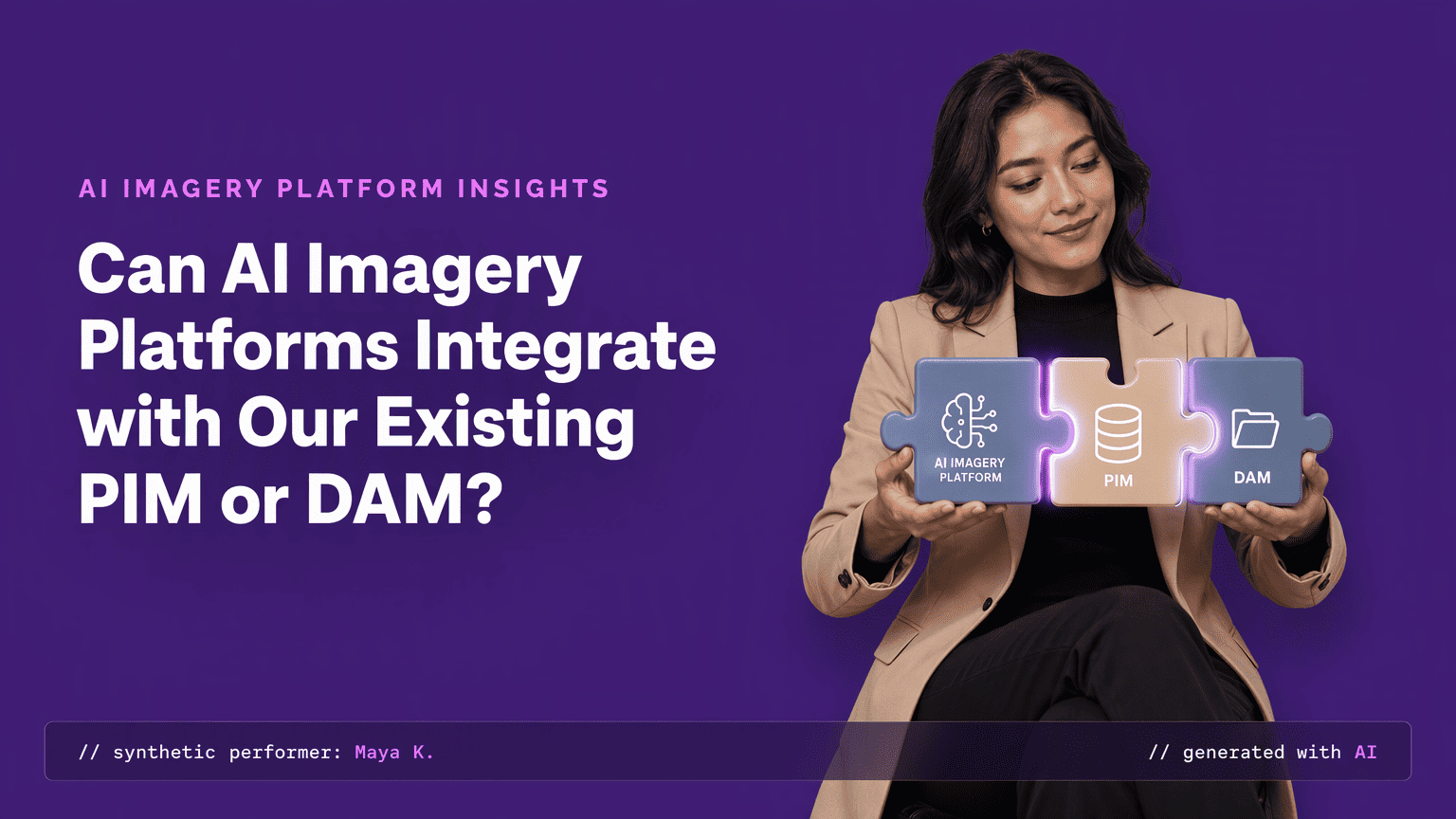
A brand-trained AI model without an integrated content supply chain is a race car without a fuel line. The workflow from raw product data to AI-ready metadata determines whether you ship publishable images before the collection launch deadline or miss it. Department stores need a system where the PIM supplies structured product attributes, the DAM holds approved reference imagery and final outputs, and the AI generation endpoint consumes both to produce on-brand variants. That synchronization does not happen through manual CSV exports and Dropbox folders.
Self-serve AI tools leave the user to handle prompting, consistency enforcement, and quality control alone. A self-serve dashboard asks the marketing manager to become a prompt engineer across 200 SKUs. That approach fails at department-store scale because it offloads brand governance responsibility onto a person who has three other jobs. Self-serve apps leave the user to handle prompting and quality control alone.
A managed AI pipeline absorbs brand direction and carries it forward. Human editors review output batches, flag distortions, and tune the model so it improves with every collection cycle. Metadata enrichment happens programmatically at ingestion, process and tagging happen together. The output is a live asset feed that the ecommerce platform pulls directly, with the correct variant surfaced for web, email, and marketplace syndication.
Step 7: Evaluate a full-pipeline AI visual infrastructure partner using a 2026 scorecard
The difference between a pilot that impresses the board and a production deployment that ships collection imagery on deadline comes down to how you weight the partner evaluation. In 2026, the most important criterion is brand-training accuracy. A partner that cannot learn your exact product signatures and render them consistently across categories is a demo, not infrastructure. From there, evaluate on four additional criteria:
Integration depth with your PIM and CMS: if the platform requires you to re-enter product data, you have already broken the supply chain; a proper integration pulls SKU attributes, colorways, and naming conventions directly from your source of truth so that generated images stay aligned with the catalog.
Output resolution and format support: must meet the specifications of every channel you sell on, from the product page to a marketplace listing to a paid social ad.
Image data security: non-negotiable; the partner must confirm where product images are processed, how they are stored, and who has access to them during training runs.
Measurable ROI: run a structured proof-of-concept, select a high-variance category, train on your archive, generate a controlled batch, and measure the conversion lift against a control group; Ghergich's pragmatic framing keeps the business case tied to immediate, attributable metrics rather than an AI-only future that has not yet arrived.
Conclusion
A department store that treats AI as a copy tool here and an image credit there will burn budget and disappoint.
The store that builds an AI-native content supply chain (starting with structured data, ending with a managed visual model trained on its own brand rules) owns product discovery speed, visual consistency, and seasonal launch economics by 2027. The integrations, the personalization taps, and the virtual-try-on layer are all mature enough to deploy this quarter.
The remaining bottleneck is the decision to build infrastructure.
See Which Fit Makes Sense for Your Catalog
If you're trying to figure out whether your actual need is a full catalog production platform or a narrower feature like a simple try-on preview, request a demo and we'll talk through the actual scope of what you're solving for, not just the platform's capabilities.
Frequently Asked Questions
What does it mean for an AI platform to be 'brand-trained' for product content, as opposed to generic image generation?
A brand-trained platform differs from a generic AI image generator in several key ways:
Catalog and identity integration: it learns from a retailer's specific catalog, logo, color palette, fit signatures, and styling rules before producing any output, while generic generators draw from a shared public library.
Competitive differentiation: because generic tools share a library, a competitor can produce imagery that looks nearly identical; brand training prevents that.
Visual consistency: brand training encodes over 200 visual attributes from reference images, delivering consistent collar construction, hemline curvature, and drape every time.
How do department stores use AI to create on-model and lifestyle imagery without traditional photoshoots?
The workflow to generate AI-powered catalog imagery from scratch follows these steps:
Train an AI model on your own brand assets: this establishes a unique visual baseline for your catalog.
Upload a flat-lay, ghost mannequin image, or packshot: this single reference serves as the source.
The model generates on-model shots, lifestyle scenes, social assets, and marketplace listings from that single reference: this eliminates studio rental, sample shipping, and model booking for basic catalog production while maintaining fit and color accuracy.
What operational and conversion metrics are associated with AI-generated product visuals in retail?
Retail deployments report a 15 to 30% conversion lift on pages using AI-generated on-model imagery compared to flat product shots. Photoshoot costs drop by 40 to 60% because studio and sample logistics are reduced, and content production accelerates by 3 to 5 times when a trained model replaces a scheduled physical shoot.
What differentiates a managed AI pipeline from self-serve AI tools for product content creation?
A managed pipeline includes dedicated oversight of model training, quality assurance by human editors, and direct integration with PIM and DAM systems. The service absorbs brand direction and enforces consistency across thousands of SKUs. Self-serve tools provide a dashboard and leave prompting, quality control, and brand governance entirely to the user, which breaks at department-store scale.
How do AI-powered virtual try-on and content multiplication features work in an ecommerce context?
Virtual try-on uses computer vision to drape a garment onto a shopper's photo or selected avatar, showing realistic fit before purchase. Content multiplication auto-generates variant images (different backgrounds, angles, model poses) from a single product shot. Both require plug-and-play ecommerce integration and a brand-trained image model to maintain output quality across every channel.
What should a department store evaluate when selecting an AI visual infrastructure partner in 2026?
Score candidates on five criteria:
Brand-training accuracy: scores the model’s fidelity to your exact brand signatures.
Integration depth: measures how tightly the solution connects with your PIM and CMS.
Output resolution and format support: verifies compatibility with every sales channel's specifications.
Image data security: ensures protection of your images during both training and processing.
Measurable conversion-lift ROI: requires a structured proof-of-concept on a high-variance category.
Sources
AI forces retailers, brands to rethink their product pages - www.modernretail.co
AI Fashion Models Built Exclusively for Your Brand - www.graswald.ai
Smarter Shopping: AI’s Role in Evolving Product Content Expectations - NIQ - nielseniq.com


Comments