What Is a Digital Twin in Fashion? The 3D File Driving the Industry’s Speed and Sustainability Reset

Introduction
Your design team just FedExed the third round of physical samples from a supplier in Portugal. The fabric drape is wrong, the color is half a shade off, and the fit review meeting is now pushed by another month.
This analogue loop of prototyping and shipping drains margin directly and piles up sustainability liabilities. A single precision-driven project can burn two years in supplier back-and-forth before design approval. That reality is why the digital twin has moved from a nice-to-have innovation to the operational backbone of modern fashion. We are going to walk through what a digital twin is, how it works, the business case for adopting one, and the infrastructure available to scale it without building an in-house 3D army.
Every sample that crosses an ocean instead of a screen costs money and time your competitors stopped spending last season. A true-to-life virtual garment that holds every stitch, fiber, and physics property lets you approve fit on a Monday and send the tech pack on Tuesday.
Key Takeaways
Here are the critical facts to understand about digital twins in fashion:
The foundation starts with the pattern. A 3D garment twin is drafted from a digital pattern and virtually sewn around an avatar. A photograph of a physical sample cannot produce the same usable asset.
Physical prototyping cost can approach zero. Tapestry slashed prototyping costs to a fraction of their original level by absorbing revision cycles in software rather than physical samples.
Structured materials like bonded seams often behave differently in reality than they do on screen.
Sustainability is a structural benefit. Adopting digital twins eliminates entire categories of physical waste, from discarded samples to air freight and excess material consumption.
Speed compression is exponential. A project that stalled for two years in physical sampling moved from concept to design approval in two weeks once digital twins and Substance 3D were applied.
At a Glance
Here is how the options compare across the dimensions that matter most.
Stage | What Happens | Key Tool Example | Output vs. Physical Sample |
Pattern import | 2D pattern pieces are uploaded or drafted around a 3D avatar | CLO3D, Browzwear | Geometry foundation; no physical counterpart yet |
Virtual sewing | Software stitches pieces along seam lines into a 3D form | CLO3D, Browzwear | 3D garment shape without fabric behavior |
Fabric physics assignment | Weight, stretch, bend, and drape properties are added to each panel | Adobe Substance 3D, CLO3D | Simulated fabric movement (e.g., silk drapes vs. denim stands) |
Approval & export | Fit and appearance are signed off; tech pack or production file is generated | Adobe Substance 3D, PLM systems | Replaces physical sample as source of truth for production |
What Exactly Is a Digital Twin in Fashion?
You glance at two images of the same jacket on a brand's site. One is a static render. The other is a digital twin. The difference matters at checkout.
A garment digital twin is a 3D file that carries the properties of a real product: pattern pieces, seam placement, fabric weight, stretch behavior, and drape. It is built in tools like CLO3D, Browzwear, or Adobe Substance 3D and functions as a working simulation. Designers can check fit, adjust a pattern, and see how the fabric falls before a single physical stitch is made.
The twin is the sample, expressed as data. A flat image has no physics. A twin embeds them.
Real-time data syncs the digital file with its eventual physical counterpart. When a team at Tapestry adjusted a handbag's hardware placement inside Substance 3D, the change rippled through every downstream view because the twin was the source of truth.
The Technical Blueprint: How a Garment Digital Twin Is Created
Building a true garment digital twin follows a layered technical sequence that turns a flat pattern into a physics-aware 3D asset. The steps below move from raw geometry to a final, validated product visual.
Draft or import the digital pattern: Each 2D piece gets positioned around an avatar in a 3D design environment. This is the starting geometry.
Virtually sew the garment: The software stitches the flat shapes along their seam lines, solving for how the three-dimensional form assembles on the body.
Assign fabric physics: Weight, thickness, stretch percentage, bend resistance, and surface texture tell the engine that silk crepe de chine drapes while rigid denim holds structure.
Run the simulation against motion: The system calculates how the assigned physics interact with the avatar's body and movement, producing a visual output that reflects real-world behavior.
Apply surface detail and PBR materials: Teams use Substance 3D Painter to generate multiple variations from a single model, applying leather grain, embroidery, or hardware finishes for marketing and retail.
The output is a reusable digital asset, ready for virtual try-on and downstream content pipelines.
Digital Twins vs. Marketing Renders and Other Technologies
A marketing render looks like a finished garment but contains no construction data. There is no seam allowance, no fabric weight, no stitch definition underneath the surface. Change the neckline and a designer has to remodel the entire asset from scratch. A digital twin recalculates the pattern and drape automatically because it knows how the pieces are cut and assembled.
Virtual try-on sits downstream from both. It maps a product image onto a person photograph or a live camera feed so a shopper can see the garment on a body. The output varies enormously depending on what feeds it.
A digital twin drives fabric-accurate distortion at stress points like shoulder seams and waistbands. A simpler version warps a flat photo the way a ghost-mannequin composite would. The two methods produce visibly different results once the body moves.
Virtual model imagery occupies a third category. A virtual model is a computer-generated person wearing a rendered garment. It replaces a human photoshoot. What it does not do is place the shopper inside the outfit. The digital twin acts as the engine that defines how the garment behaves.
The virtual model provides the display. Virtual try-on creates the interactive layer. Treating them as interchangeable pushes budget into a render farm that delivers pictures instead of a production pipeline that delivers reusable, measurable assets.
The Core Business Case: Speed, Cost, and Sustainability
Tapestry's Digital Product Creation team took a project that was stuck at the supplier level for two years from concept to design approval within two weeks using digital twins and Substance 3D. That single example compresses the entire value proposition into one timeline: two years reduced to fourteen days.
The cost side is just as stark. By integrating their 3D pipeline, Tapestry brought prototyping expenses down to a fraction of their original level. Physical sampling is expensive. You pay for materials, shipping, duties, and the labor of repeated corrections. A digital twin absorbs those iterations in software, where errors cost time but not fabric.
Sustainability wraps into both levers. Fewer physical samples mean fewer discarded garments, less air freight, and lower material waste. The Adobe team flagged this explicitly for Coach's sub-brand Coachtopia, where lifelike digital samples help cut physical waste. Digital twin adoption eliminates entire categories of resource consumption that traditional sampling requires.
From One File to Every Channel: The Unified Asset Pipeline
Most brands stop using the twin once the physical sample is approved. The file gets archived, and every downstream team starts over with flat photography and guesswork. That is the expensive way to work.
The smarter path follows a "create once, use many" mindset. An integrated digital twin framework rests on three pillars: Smart Design, Intelligent Manufacturing, and Collaborative Innovation. Smart Design covers the prototyping and pattern-drafting phase. Intelligent Manufacturing feeds the twin into production planning and quality checks. Collaborative Innovation connects cross-team input, supply-chain responsiveness, and e-commerce deployment.
When you unify those pillars, the output reaches everywhere. The same file that validated fit in design drives the PLM system, feeds color and material variations to the site, and populates the virtual try-on experience. You avoid orphaned 3D assets and the duplicate work that inflates studio calendars. The pipeline shifts from a sequence of handoffs to a shared truth. That change alone can unlock faster seasonal launches and visual consistency across global storefronts.
The 2026 US Landscape: Providers, Adoption, and Friction Points
Adoption is scaling, but the field remains fragmented. CLO3D and Browzwear dominate design-side twin creation. Adobe’s Substance 3D toolset has gained ground for surface detailing and variation generation. Shopify reports that products with 3D or AR content see up to 94% higher conversion, which is pushing e-commerce teams to demand workable twin outputs.
The friction lives in file formats. CLO3D, Browzwear, and various e-commerce 3D viewers do not all speak the same language natively. A conversion layer is usually required to move a twin from the design tool to the storefront without losing detail. That conversion step introduces data loss, extra labor, and the kind of quality gap that makes creative teams abandon the pipeline mid-way.
Organizational silos are the second drag. Design builds the twin. Marketing reshoots flat photography because they do not trust the 3D output. E-commerce runs separate ghost mannequin photography. Each division operates with its own visual standard and software stack.
Until a brand-level mandate treats the twin as the single source of truth across PLM, storefront, and advertising, the efficiency case stays theoretical. Managed services are emerging in response to that coordination problem.
How Managed Services Unlock Digital Twin Potential Without In-House Teams
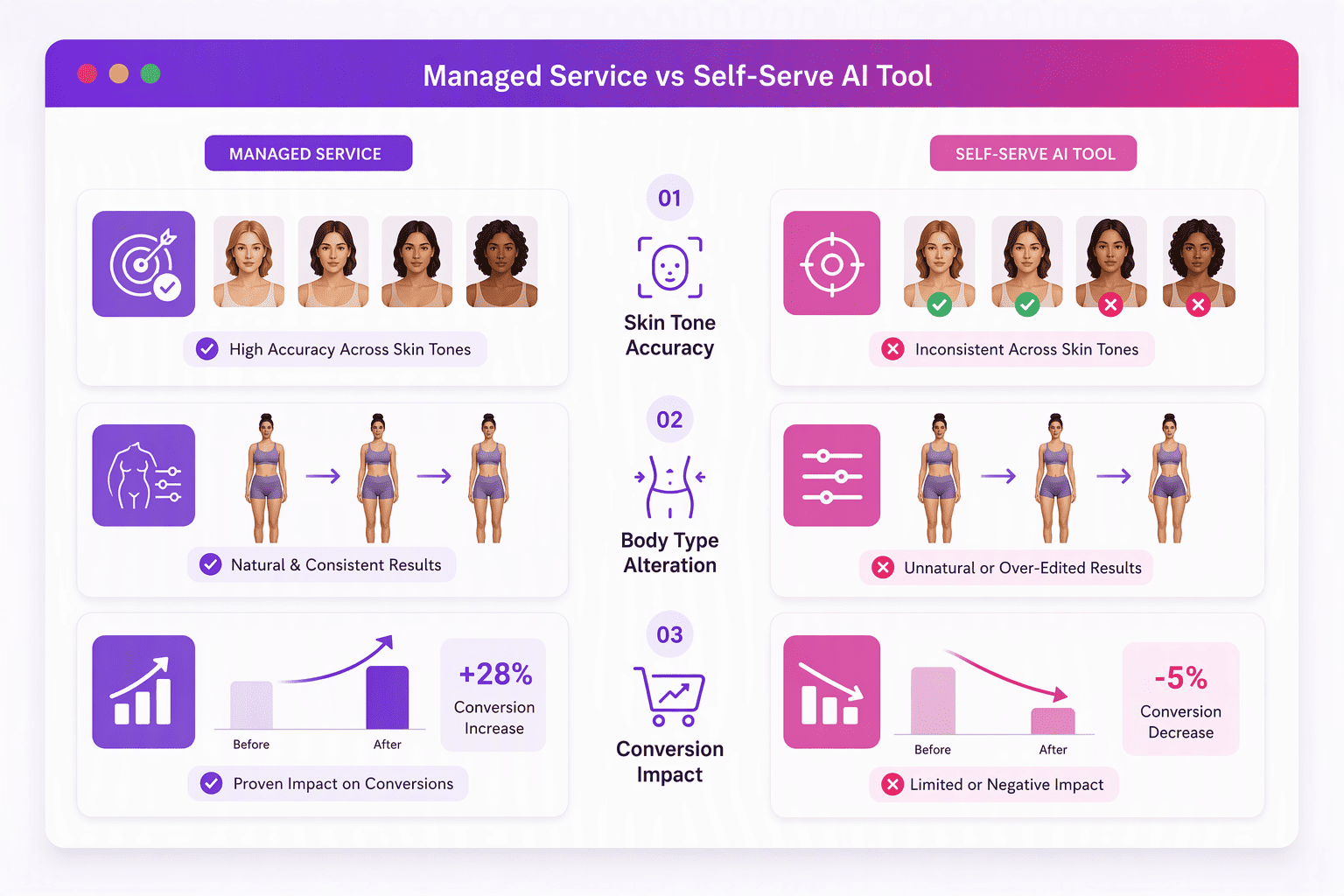
Building an internal digital product creation team like Tapestry's takes capital, specialized 3D talent, and roughly two years of pipeline development. Most brands cannot stop production to hire six CLO3D specialists. A managed, full-stack visual platform offers a different route. Lumesa.ai runs the visual production line for fashion brands, trains on your style guide, preserves your exact styling language and fit standards, and places finished images directly into your storefront.
The service activates every downstream use of the twin. You never open cloth simulation software. A brand-trained system absorbs your visual language, composition rules, and product details, then generates on-model editorial shots, e-commerce packshots, social variants, and virtual try-on experiences from one source file. Digital twin models retain ownership and earn from each use, shifting the cost model away from per-session rendering fees.
You stay a brand, not a software company. Tested visuals deploy straight into storefronts and workflows, with the cross-channel reporting and optimization loop an internal team would otherwise spend months building. Virtual try-on becomes practical here. The technology has been reported to increase sales by up to 30% and reduce return rates by approximately 20%, numbers that reward the brand that closes the distance between the design file and the shopper's body.
Conclusion
A digital twin is the computational version of a garment, carrying the data that drives every decision from first pattern to final doorstep. When it works end to end, the numbers are hard to argue with: 94% higher conversion on 3D-enabled product pages, prototyping costs cut to a fraction, and timelines that collapse from years to weeks.
The gap in 2026 is not the technology. The gap is the handoff. Brands that treat the twin as a one-department tool leave it in a folder and pay for photography twice. Brands that unify design, manufacturing, and e-commerce around a single asset turn the twin into a multiplier. That means tackling format fragmentation, organizational habits, and the review step that bridges simulation accuracy with real-world fabric behavior.
The spectrum of execution runs from building an in-house DPC operation to engaging a managed service that handles the full downstream pipeline. Either way, the direction is clear. The brands moving fastest are the ones that refuse to archive the file. They let it do its job.
See Which Fit Makes Sense for Your Catalog
If you're trying to figure out whether your actual need is a full catalog production platform or a narrower feature like a simple try-on preview, request a demo and we'll talk through the actual scope of what you're solving for, not just the platform's capabilities.
Frequently Asked Questions
What exactly is a digital twin in the context of fashion and apparel?
It is a high-fidelity 3D file that carries a garment's physical properties, including pattern pieces, seam placement, fabric weight, stretch behavior, and drape. Unlike a simple static render, a digital twin is a physics-based simulation used to validate fit and construction decisions before cutting physical fabric.
How does creating a digital twin of a model or garment actually work, technically?
The process begins by digitizing 2D pattern pieces into a 3D environment via tools like CLO3D or Browzwear. You assign physical properties like fabric weight and stretch, virtually 'sew' the panels together, and then run a physics simulation to see how the garment behaves on an avatar before validating the fit and making size grades.
What are the main business benefits for fashion brands and retailers using digital twins?
The core advantages of digital twins are:
Speed: compresses approval cycles from two years to two weeks.
Cost: drastically reduces physical sampling expenses.
Sustainability: minimizes waste and shipping.
Conversion: lifelike 3D assets can reduce return rates and have been shown to increase e-commerce conversion rates by up to 94%.
How do digital twins differ from related technologies like virtual try-on and ghost mannequin photography?
These three concepts are not interchangeable:
Digital twin: an operational simulation of the product for internal design and fit review.
Virtual try-on: a consumer-facing overlay for a shopper's photo or camera.
Ghost mannequin shots: flat 2D images of a physical sample with the mannequin edited out, not 3D files.
What does the 2026 landscape of digital twin providers and adoption look like in the US market?
Adoption is scaling beyond experimentation, with three main friction points:
File format interoperability: between tools like CLO3D, Browzwear, and e-commerce viewers.
Internal organizational silos: that prevent cross-team collaboration.
Specialized skills gap: for 3D artists.
Sources
Universal appeal? A flow theory perspective on the adoption of digital twin-based fashion technology - ScienceDirect - www.sciencedirect.com
How Tapestry is scaling fashion design with digital twins and Substance 3D | Adobe Blog - blog.adobe.com
Digital Twins in Fashion: From Runway to Try-On | YourSizer - www.yoursizer.com

Comments